
Omnibus – good or bad?

This blog examines omnibus legislation as a legislative tool in the European Union. The term omnibus comes from Latin, meaning “for all.” An omnibus regulation or directive is a legislative instrument that simultaneously amends several existing regulations in different policy areas. It reflects the ability of the regulatory instrument to combine numerous amendments contained in separate regulations into a coherent whole.
This blog is based on a research article by Alberto Alemanno, which critically examines the pros and cons of omnibus regulation from the perspective of legislative preparation.
Omnibus legislation in the EU refers to a regulatory technique in which amendments from several different policy areas are compiled into a single regulation or directive. Originally, it was rare and intended mainly for administrative simplification, but since 2025 it has become a key tool in the EU’s regulatory simplification program.
Why is omnibus legislation problematic?
According to Alemanno, omnibus legislation is currently being used in a way that circumvents constitutional procedural rules:
1. Bypassing procedures
Omnibus proposals bypass the normal requirements of the legislative process, such as: – public hearings – impact assessments – interdepartmental consultations – better regulation toolkit requirements. E.g. none of the 2025 omnibus packages were prepared with a proper impact assessment.
2. Competitiveness as justification – a permanent exception in practice
The Commission justifies the lack of assessments by citing the urgency of competitiveness, which has become a general exception rather than an exceptional case. This undermines the principle of proportionality under the EU Treaties.
3. Lack of evidence
According to the principle of proportionality, EU institutions must demonstrate that they are acting on the basis of sufficiently strong evidence. The omnibus packages lack such evidence, as no assessments or analyses have been carried out.
4. Weakening of participatory democracy
Consultations have been replaced by closed meetings with selected industries, which means that: – civil society organizations – employees – affected communities are completely excluded.
5. Omnibus I as an example
In the Omnibus I package (including CSRD and CSDDD amendments): – threshold increases and exemptions were made without assessing alternatives – the reduction of due diligence obligations was made without an analysis based on risk models – the format was deliberately used to avoid normal procedures.
Is omnibus illegal?
No. Omnibus is not in itself contrary to EU law, and it has benefits such as consolidating regulation, improving consistency, and reducing administrative burdens. However, its current use constitutes a “constitutional exception” if procedures are systematically circumvented.
What should be done?
Alemanno proposes that omnibus legislation should be brought back on track:
- Procedural safeguards should be codified, such as: – objective justification for consolidation – substantive link between the amendments – compliance with specific restrictions.
- The restrictions on the consolidation of delegated acts should be taken as a model.
- The following should be reinforced: – mandatory impact assessments – open and broad consultation and requirements for demonstrating the principle of proportionality.
Advantages and disadvantages of omnibus legislation:
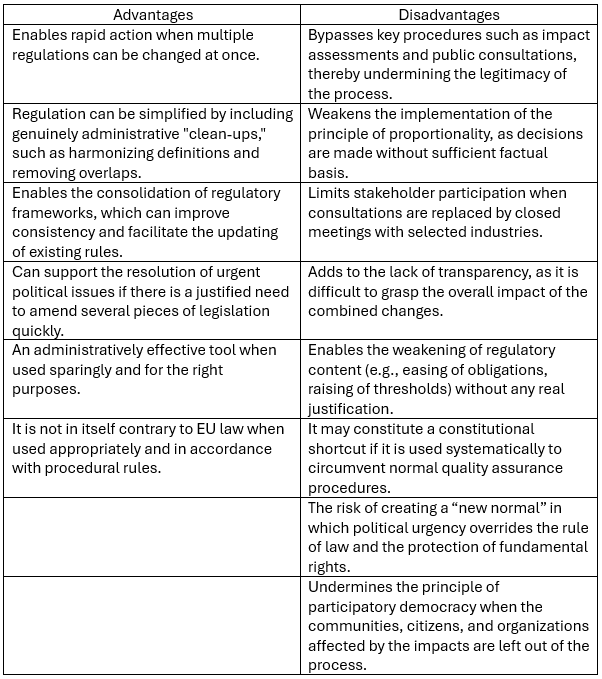
What is at stake?
Finally, Alemanno poses a fundamental question: Is this just a single case of abuse, or is it the birth of a new constitutional norm? The choice will determine whether the EU remains a constitutional state, where political objectives are subordinate to legality, or whether legality is subordinated to the demands of political urgency and efficiency.
Author: Kaisa Sorsa
Global Gateway Research Group
Source: Alberto Alemanno (2025) The Omnibus Road to Constitutional Drift. How the Rise of Omnibus Legislation Undermines Procedural Integrity in the EU. https://verfassungsblog.de/omnibus-legislation-europe-constitutional/